
Disclosure: We are reader-supported. If you buy through links on our site, we may earn a commission. Learn more.
For much of American history, the dollar represented something tangible: a fixed amount of gold.
Americans could exchange paper currency for physical gold, and the government was expected to maintain that promise. The arrangement placed real constraints on monetary policy, limiting how freely officials could expand the money supply without putting the nation's gold reserves at risk.
That system no longer exists.
Since 1971, the U.S. dollar has operated without a fixed link to gold. Its value depends instead on monetary policy, economic conditions, and confidence in the American government and financial system.
So why did the United States abandon the gold standard? Was it an outdated monetary system that needed replacing, or did removing gold from the equation open the door to decades of inflation, expanding debt, and declining purchasing power?
To understand the debate, we need to look at how the gold standard worked, why it collapsed, and what its disappearance means for Americans saving for retirement today.

Protect Your Savings with Physical Gold and Silver
Claim Your Free "Ultimate" Gold IRA Guide Today.
What Was the Gold Standard?
The gold standard was a monetary system in which a country's currency was tied to a fixed quantity of gold.
Under a traditional gold standard, the government established an official exchange rate between its currency and gold. Currency holders could exchange money for the corresponding amount of the precious metal, subject to the rules in effect at the time.
For example, when gold was officially valued at $20.67 per troy ounce, approximately $20.67 represented one ounce of gold.
This convertibility created an important constraint on government monetary policy.
If a government issued more currency than people believed its gold reserves could support, holders might begin exchanging their paper money for physical gold. Large-scale redemptions could drain the country's reserves, potentially forcing policymakers to change course.
In principle, the system encouraged monetary discipline, helped establish predictable exchange rates, and limited governments' ability to create money without consequences.
But it wasn't foolproof. Gold supplies could fluctuate, prices could rise or fall, and governments could suspend convertibility during wars or financial emergencies.
The gold standard was a constraint on monetary policy, not a guarantee of economic stability.
Related: GoldIRASecrets TV Premieres with an In-Depth Guide to Gold and Silver IRA Rollovers
How the Gold Standard Shaped America's Economy
America's relationship with gold began long before the Federal Reserve existed.
In 1834, Congress adjusted the legal relationship between gold and silver, helping establish gold as the dominant monetary metal in the United States.
The country did not immediately adopt the fully developed gold standard associated with later decades. Following disruptions during the Civil War, the U.S. resumed gold convertibility in 1879. The Gold Standard Act of 1900 subsequently formalized the dollar's gold-based monetary system.
The Classical Gold Standard: 1870–1914
The late 19th and early 20th centuries are commonly described as the classical gold standard era.
During this period, major economies, including Great Britain, Germany, and the United States, operated monetary systems linked to gold.
This created a relatively predictable framework for international trade.
Because participating currencies were connected to gold at established rates, businesses could trade across borders with less uncertainty about changes in exchange rates.
Gold also provided a mechanism for correcting international financial imbalances.
Consider a simplified example.
If Britain imported significantly more goods than it exported, gold could flow out of Britain to settle international balances. That loss of gold could tighten monetary conditions, placing downward pressure on British prices and making British goods more competitive internationally.
The reverse could happen in countries receiving gold.
These adjustments weren't always smooth, but they helped link international monetary conditions through a common standard.
The period coincided with industrial expansion, growing international trade, and significant economic development.
However, it would be misleading to attribute all of that growth to gold. Technological innovation, industrialization, transportation improvements, and expanding global markets also played major roles.
Related: GoldenCrest Metals Review - Best for Physical Gold and Silver?
Why World War I Disrupted the Gold Standard
The First World War exposed one of the greatest challenges facing a gold-backed monetary system.
Wars are extraordinarily expensive.
Governments need to finance weapons, troops, equipment, and other expenditures, often on a scale far beyond normal government budgets.
Maintaining gold convertibility can make financing those expenditures more difficult because governments cannot expand their monetary obligations indefinitely without risking demands for gold redemption.
During World War I, several participating countries suspended or restricted gold convertibility, allowing them greater flexibility to borrow and finance wartime spending.
After the war, governments attempted to restore international gold arrangements, but the system was considerably more fragile.
Economic conditions had changed, government debts had expanded, and restoring prewar currency values proved difficult.
Those weaknesses became especially significant during the Great Depression.
The Great Depression and Roosevelt's Gold Policies
The stock market crash of 1929 and the subsequent economic collapse placed enormous pressure on the international monetary system.
As banks failed and confidence deteriorated, people sought the perceived security of gold.
Governments faced an increasingly difficult choice: maintain their commitment to gold convertibility or adopt policies designed to stabilize banks, stimulate economic activity, and combat deflation.
Britain abandoned gold convertibility in 1931.
The United States followed a different path under President Franklin D. Roosevelt.
Related: How to Diversify Your Savings with Physical Gold and Silver (Tax-Free)
Protect Your Savings with Physical Gold and Silver
Claim Your Free "Ultimate" Gold IRA Guide Today.
1933: Americans Lose the Right to Redeem Dollars for Gold
In 1933, Roosevelt suspended domestic gold convertibility and imposed sweeping restrictions on monetary gold ownership and transactions.
Executive Order 6102 required individuals and businesses to surrender most gold coins, gold bullion, and gold certificates, subject to specified exemptions, in exchange for paper currency.
The government was attempting to stop gold outflows and gain greater control over the nation's monetary system.
For ordinary Americans, the implications were profound.
A dollar was no longer a promise that could be redeemed for a fixed quantity of gold upon demand.
1934: Roosevelt Changes the Price of Gold
The following year, the Gold Reserve Act of 1934 transferred monetary gold holdings to the U.S. Treasury and formalized major changes to the monetary system.
The official price of gold increased from $20.67 to $35 per ounce.
That might sound like gold simply became more valuable, but the change also meant something important about the dollar.
Each dollar now represented substantially less gold than before.
At $20.67 per ounce, one dollar represented approximately 0.0484 ounces of gold.
At $35 per ounce, one dollar represented approximately 0.0286 ounces.
The gold content of the dollar had been reduced by roughly 41%.
This deliberate devaluation was intended to increase monetary flexibility and help counter the deflation that had devastated the economy.
Whether Roosevelt's broader economic policies helped or hindered recovery remains a subject of historical and economic debate.
But there is an important distinction: many economists argue that the constraints of the international gold standard contributed to the severity of the Great Depression by restricting monetary responses and transmitting deflation between countries.
Gold provided monetary discipline, but that discipline could become a liability during a major financial crisis.
Bretton Woods: The Dollar Becomes the Center of the Global Monetary System

Bretton Woods
In July 1944, representatives from 44 nations gathered in Bretton Woods, New Hampshire, to establish a new international monetary order.
The agreement created a system built around the U.S. dollar.
Under Bretton Woods, participating countries maintained fixed, adjustable exchange rates against the dollar, while the United States committed to converting dollars held by foreign monetary authorities into gold at $35 per ounce.
In effect, gold remained the foundation, but the dollar became the principal international link to it.
The arrangement also helped establish two major international financial institutions: the International Monetary Fund and the World Bank.
The United States emerged from World War II with tremendous economic strength and substantial gold reserves. That position helped make the dollar the leading currency for international reserves and transactions.
For a time, the system worked.
International trade expanded, economies rebuilt after the war, and the dollar occupied a uniquely influential position.
But the arrangement contained an underlying contradiction.
The world needed an expanding supply of dollars to support international trade and reserves. Yet the more dollars circulated overseas, the harder it became for the United States to maintain confidence that those dollars could be exchanged for its limited gold reserves.
Eventually, that tension became impossible to ignore.
Related: How to Diversify Your Savings with Physical Gold and Silver (Tax-Free)
1971: President Nixon Closes the Gold Window
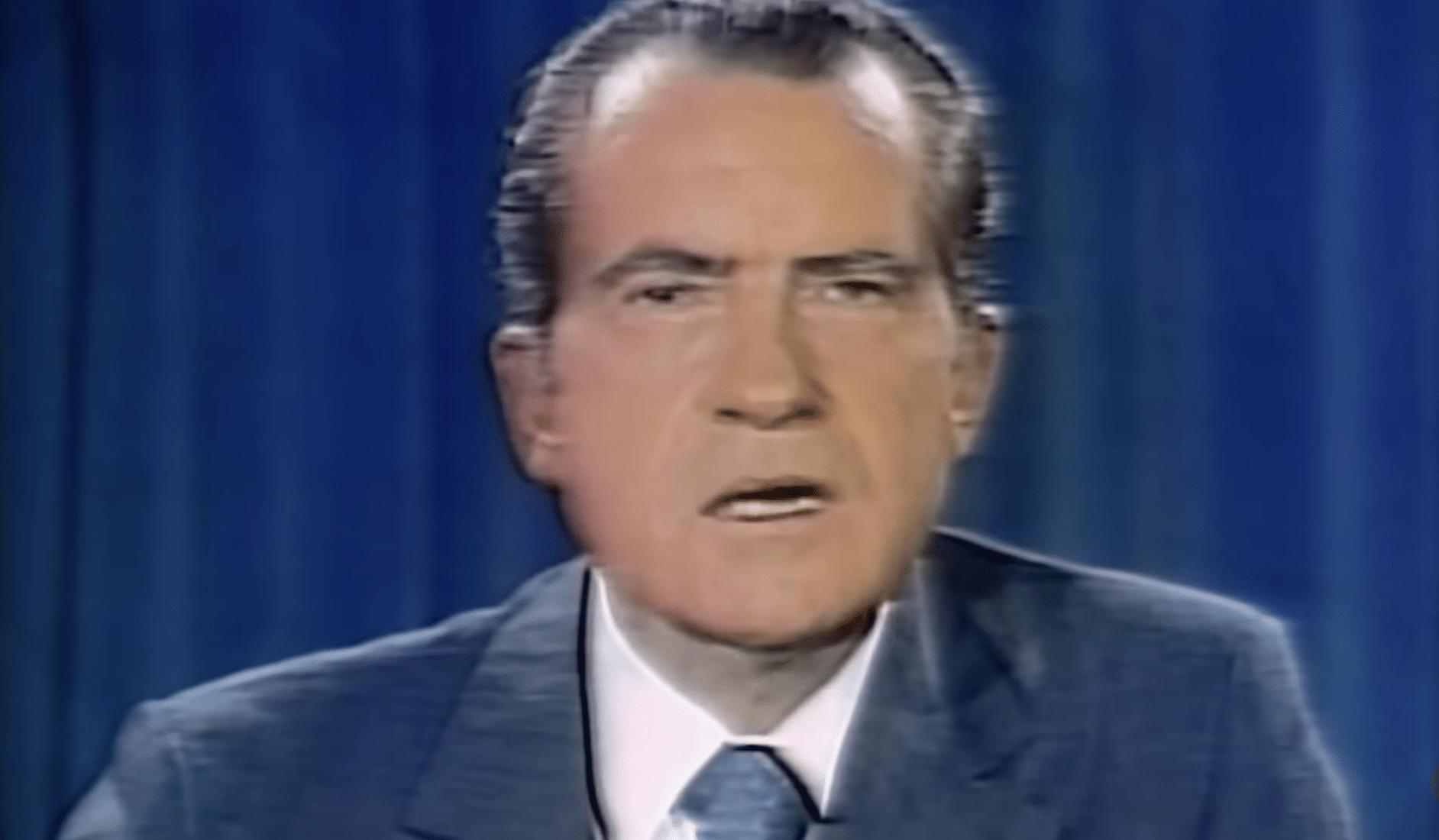
Richard Nixon
By the 1960s, the United States was facing growing monetary pressures.
Federal spending increased as the country financed the Vietnam War and expanded domestic programs, including President Lyndon Johnson's Great Society initiatives.
Meanwhile, the volume of dollars held overseas continued to grow.
Foreign governments began questioning whether the United States possessed sufficient gold to honor its international commitments.
Some demanded gold in exchange for their dollar holdings, adding pressure to America's reserves.
On August 15, 1971, President Richard Nixon announced that the United States would suspend the dollar's convertibility into gold for foreign monetary authorities.
The decision became known as the Nixon Shock.
Although initially presented as temporary, the suspension marked the decisive end of the dollar's direct international convertibility into gold.
The fixed-exchange-rate system continued to unravel, and by 1973 major currencies had largely shifted toward floating exchange rates.
The modern era of fiat money had arrived.
Related: 9 Economic Risks That Could Threaten America's Growth
What Happened to the Dollar After 1971?
Before 1971, gold had provided an external constraint on the international monetary system.
After the dollar's connection to gold ended, the Federal Reserve gained greater flexibility to influence monetary conditions without maintaining a fixed gold exchange rate.
That flexibility came with benefits and risks.
Central banks could respond more aggressively to financial crises, adjust interest rates, and expand monetary support when necessary.
But governments and central banks also had greater room to pursue policies that could contribute to inflation.
The difference matters because inflation gradually reduces the purchasing power of money.
When the prices of goods and services rise, each dollar buys less than it did previously.
A household might have a higher nominal income than its grandparents did decades ago, yet still struggle with expenses that have increased substantially.
According to the Bureau of Labor Statistics' Consumer Price Index, the purchasing power of the dollar has declined dramatically since the early 1970s.
That erosion is an important part of the modern retirement challenge.
Someone who saves $100,000 in cash may still have $100,000 decades later, but what that money can purchase may be substantially less.
Of course, cash held in interest-bearing accounts can earn income, and wages and other assets may also appreciate over time.
Nor can all post-1971 inflation be attributed solely to the end of the gold standard. Energy shocks, fiscal policy, supply constraints, monetary decisions, and broader economic forces all influence prices.
Still, the historical contrast raises a legitimate question: Without a fixed monetary anchor, what protects the long-term purchasing power of a nation's currency?
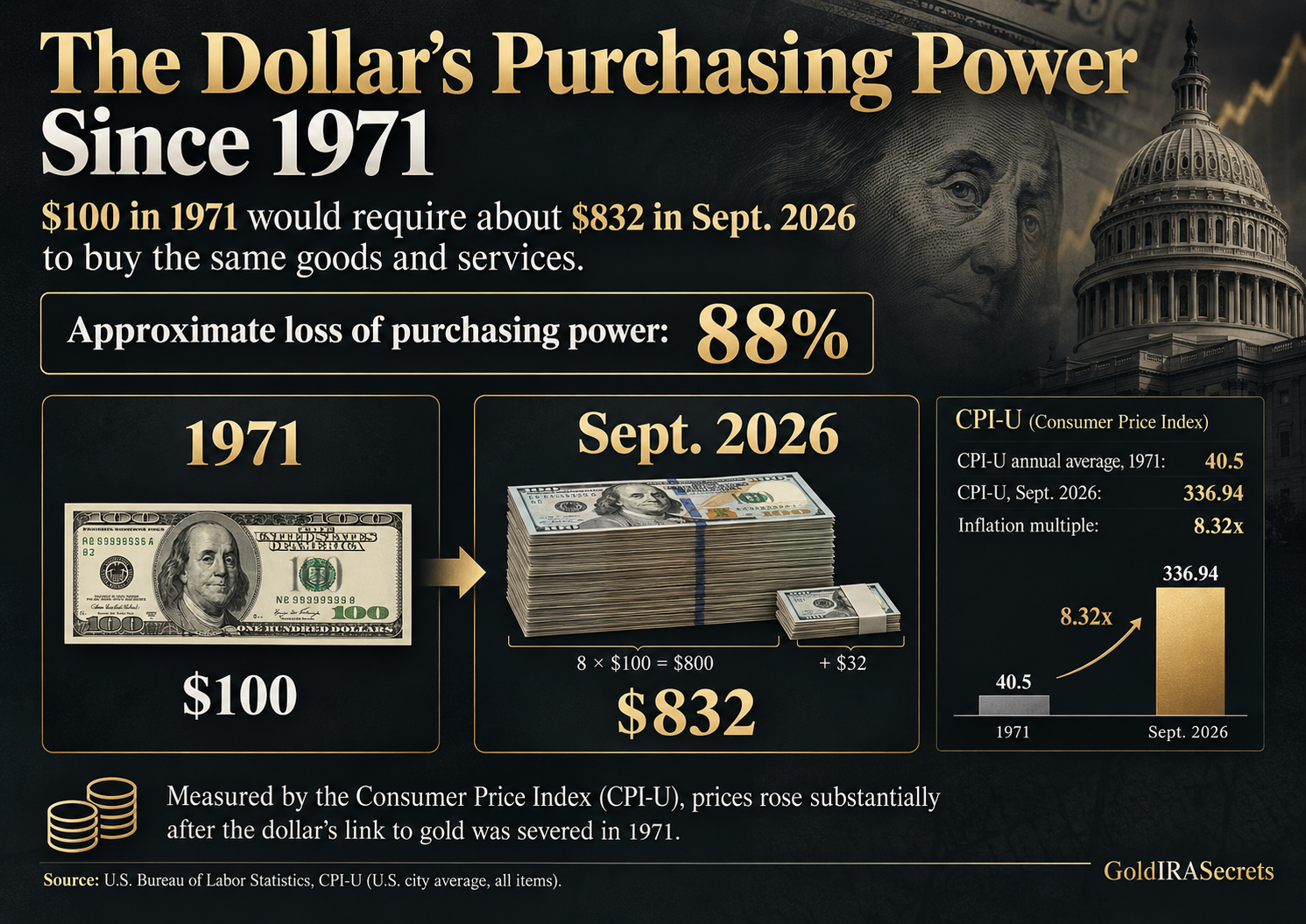
The dollar's purchasing power since 1971
Could the United States Return to the Gold Standard?
Calls to restore the gold standard tend to gain attention during periods of elevated inflation, rising government debt, and declining confidence in monetary policy.
Supporters argue that returning to gold would impose greater discipline on government spending and monetary expansion.
A government committed to redeeming dollars for a fixed amount of gold would have to take that obligation seriously.
Advocates also argue that a credible gold standard could help stabilize the value of money over long periods.
Critics see substantial problems with this approach.
A gold standard limits a central bank's ability to respond to financial crises and severe recessions. Changes in global gold production and demand can influence monetary conditions even when those changes have little to do with the underlying economy.
Restoring convertibility would also require difficult decisions about the official gold price, the amount of currency eligible for redemption, and the government's ability to maintain the system during periods of stress.
Perhaps most importantly, a gold standard does not eliminate financial crises, banking failures, inflation, or deflation.
Returning to gold would therefore involve substantial economic tradeoffs, rather than providing a simple cure for monetary instability.
Related: How to Diversify Your Savings with Physical Gold and Silver (Tax-Free)
Protect Your Savings with Physical Gold and Silver
Claim Your Free "Ultimate" Gold IRA Guide Today.
Is the U.S. Dollar Losing Its Status as the World's Reserve Currency?
Another concern frequently raised by gold advocates is whether growing U.S. debt and monetary expansion could eventually weaken the dollar's international standing.
The dollar remains the dominant currency in global foreign exchange reserves, international finance, and many cross-border transactions.
However, foreign central banks are not required to hold all their reserves in dollars.
They can diversify into other currencies and gold.
According to the International Monetary Fund, the dollar represented approximately 56.7% of allocated global foreign exchange reserves in the second quarter of 2026.
That remains a substantial share, but it also illustrates that the dollar's global position depends on continued confidence rather than gold convertibility.
The dollar benefits from deep U.S. financial markets, widespread international use, and a large, diversified American economy.
Those advantages should not be underestimated.
At the same time, persistent fiscal deficits, rising debt-servicing costs, geopolitical tensions, and changes in international trade arrangements create legitimate questions about the dollar's long-term position.
A sudden collapse of the dollar's reserve status is not inevitable. Nevertheless, the global monetary system can change over time, just as it changed in 1933, 1944, and 1971.
Related: What Happens to Your Gold IRA if Your Gold Company Goes Out of Business?
Why the History of the Gold Standard Still Matters for Retirement Savers
Most Americans aren't particularly concerned with the technical details of international monetary arrangements.
They're concerned with whether their retirement savings will be enough to support them in the years ahead.
And that's where the history of the gold standard becomes relevant.
A retirement account balance tells you how many dollars you've accumulated. It doesn't necessarily tell you how much those dollars will purchase 10, 20, or 30 years from now.
Inflation can quietly change that equation.
Gold has historically attracted attention during periods of monetary uncertainty because it is a tangible asset that cannot be created through government monetary policy.
Unlike paper currency, physical gold does not represent a promise to pay issued by a central bank or government.
Its supply is limited by geological availability, mining production, and existing above-ground inventories.
That doesn't mean gold always rises when inflation increases, or that its purchasing power remains constant over shorter periods.
Gold prices can fluctuate significantly, and physical precious metals don't pay interest or dividends.
Nevertheless, some retirement savers choose to hold a portion of their assets in gold or silver as part of a broader diversification strategy.
A self-directed Gold IRA is one way eligible Americans can hold certain IRS-approved precious metals within a tax-advantaged retirement account, subject to applicable rules, fees, and custody requirements.
Others prefer purchasing physical gold and silver outside retirement accounts.
The appropriate approach depends on individual circumstances, retirement timelines, liquidity needs, and risk tolerance.
Related: How to Diversify Your Retirement Savings with Physical Gold and Silver
Gold, Government, and the Future of Money
The history of the gold standard is ultimately a history of changing relationships between money, governments, and public confidence.
For generations, the dollar was connected to a defined quantity of gold. That arrangement constrained monetary policy but also introduced its own economic challenges.
Today, the dollar operates under a different system, supported by the strength of the U.S. economy, monetary institutions, and confidence in the government's ability to meet its obligations.
Whether that system will continue to serve Americans well is a question worth examining.
But understanding monetary history doesn't require believing that the gold standard was perfect or that fiat money is destined to fail.
It requires recognizing that the number of dollars you own and the purchasing power those dollars represent are two very different things.
For Americans approaching retirement, that distinction may be more important than ever.
Frequently Asked Questions
When did the United States go off the gold standard?
The United States ended domestic gold convertibility in 1933 under President Franklin D. Roosevelt. In 1971, President Richard Nixon suspended the dollar's convertibility into gold for foreign monetary authorities, effectively ending the remaining international gold link.
What was the price of gold under the gold standard?
The official U.S. gold price was approximately $20.67 per troy ounce before the Roosevelt administration's changes. In 1934, the official price was increased to $35 per ounce, a rate subsequently maintained under the Bretton Woods system.
Is the U.S. dollar still backed by gold?
No. The U.S. dollar is a fiat currency, meaning its value is not fixed to gold or another physical commodity. Its purchasing power depends on economic conditions, monetary policy, and confidence in the currency.
Did abandoning the gold standard cause inflation?
Abandoning the gold standard removed an important constraint on monetary policy, but inflation has multiple causes. Monetary expansion, supply shocks, fiscal policy, and changes in demand can all influence inflation. Gold-backed economies also experienced periods of inflation and deflation.
Could America bring back the gold standard?
In principle, Congress could establish a new gold-linked monetary framework. However, doing so would create major challenges involving currency convertibility, gold reserves, banking operations, and monetary policy.
Is buying physical gold the same as returning to the gold standard?
No. Individuals can purchase and own physical gold under today's fiat monetary system. Holding gold does not make the dollar redeemable for gold or restore the gold standard.
Free Guide Reveals Strategies to Diversify Your Portfolio with Physical Gold & Silver
Disclaimer: This article is for educational purposes only and does not constitute individualized financial, tax, or legal advice. Precious metals involve price volatility, dealer spreads, storage expenses, and other considerations. Consult qualified professionals before making retirement account decisions.
