
Disclosure: We are reader-supported. If you buy through links on our site, we may earn a commission. Learn more.
Saving for retirement and living on those savings require different decisions. Once the paychecks stop, market declines, rising prices, and unexpected expenses can put a retirement plan under pressure.
In Episode 2 of Gold IRA Secrets TV, host Laura Beth Ezzell speaks with Devlyn Steele, director of education at Augusta Precious Metals, about the biggest retirement mistakes after 50. Their conversation covers the jobs different assets should perform, why diversification takes more than owning several funds, and what buyers should understand before purchasing physical gold or silver.
Watch the Full Interview
Want to explore the precious metals portion of the discussion? Request Augusta’s free Ultimate Gold IRA Guide, or call 877-580-2357 to learn more about its educational resources.

Protect Your Savings with Physical Gold and Silver
Claim Your Free "Ultimate" Gold IRA Guide Today.
1. A Strategy for Building Savings May Need to Change in Retirement
During your working years, a market decline may give you time to keep contributing and wait for a recovery. Retirement changes that equation because you may need to withdraw money from the same portfolio that has fallen in value.
Steele illustrates the problem with a hypothetical $1 million account. A 30% decline reduces it to $700,000. If the owner then withdraws $50,000 for living expenses, only $650,000 remains invested.
That remaining balance would need to rise roughly 54% to reach $1 million again, assuming no further withdrawals. Without the withdrawal, the $700,000 balance would need to rise about 43%.
This helps explain sequence-of-returns risk: the order of investment returns matters when money is moving out of an account. Losses early in retirement, combined with ongoing withdrawals, can make a recovery harder.
The account can still recover. The concern is that selling investments to cover spending leaves fewer dollars participating in a rebound. Planning where withdrawals will come from deserves as much attention as choosing investments.
2. Measure Retirement Readiness in Purchasing Power
A retirement account balance tells you how many dollars you have. It does not tell you how much those dollars will buy in 10 or 20 years.
In the interview, Steele uses a $50,000 annual lifestyle to explain the cumulative effect of inflation. At a hypothetical 3% annual inflation rate, maintaining the same purchasing power would require approximately:
Years from now | annual spending needed |
|---|---|
Today | $50,000 |
10 Years | $67,196 |
20 Years | $90,305 |
30 Years | $121,363 |
These figures illustrate compounding, rather than predict future inflation. They assume the same basket of expenses rises by 3% each year.
Your own costs will depend on your circumstances. Healthcare, housing, insurance, transportation, and family responsibilities can change independently of a headline inflation measure.
A useful planning question is whether your expected income and withdrawals can support your spending as prices change, including the possibility that some expenses grow faster than anticipated.
3. Give Each Asset a Job
One of the most useful ideas in the conversation is to ask what you need an asset to accomplish before judging its performance.
The discussion identifies six jobs for retirement savings:
Job | question to ask |
|---|---|
Growth | Can this help fund spending over a long retirement? |
Income | Can it generate cash flow for recurring expenses? |
Accessibility | Can I access money when I need it? |
Stability | Can it help limit fluctuations in the money I depend on? |
Preserving purchasing power | Can it help address rising costs over time? |
Diversification | DOes it expose me to different risks from my other holdings? |
An asset can serve more than one purpose, and each comes with trade-offs. Stability and purchasing-power protection, for example, are different goals. Cash may provide a relatively steady nominal balance while losing purchasing power over time.
Steele’s example is an emergency fund. A couple might regret keeping cash on hand while stocks rise. But if their air conditioner fails during a market downturn, that reserve can cover the repair without forcing a stock sale.
The cash did its job even though another investment earned more. Comparing every holding solely by its recent return can encourage decisions that undermine the rest of a retirement plan.
4. Several Funds Can Still Leave You Concentrated
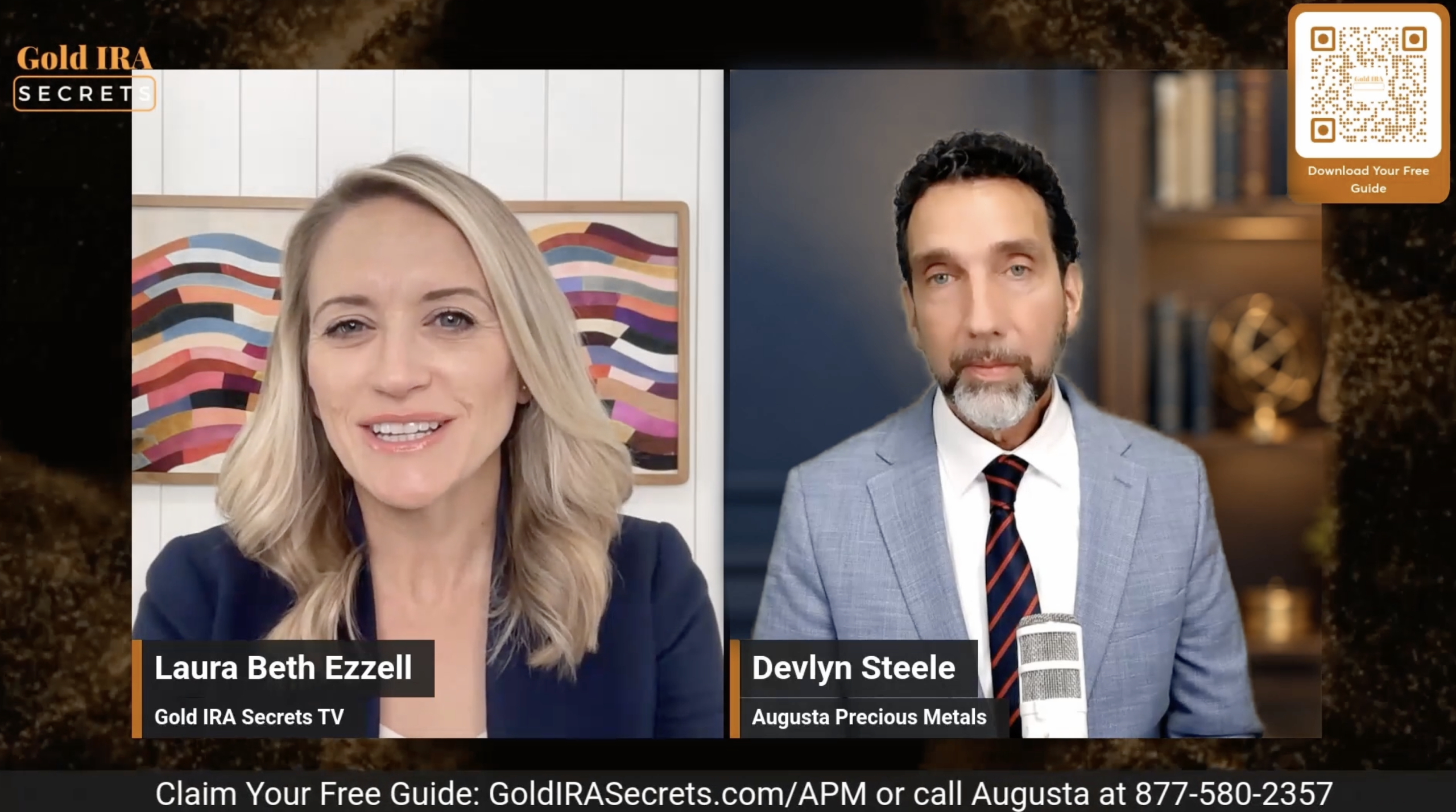
Devlyn Steele joins Laura Beth Ezzell on Gold IRA Secrets TV
Owning an S&P 500 fund, a technology fund, and individual technology stocks can create more overlap than the account statements suggest.
The number of holdings alone does not tell you how diversified you are. Several funds may own the same large companies or respond to similar economic conditions.
Steele encourages retirement savers to examine what is underneath the account labels. Consider your exposure across workplace plans, IRAs, and taxable accounts together. Look at overlapping companies, sectors, asset classes, and sources of income.
Diversification can help spread risk, but it does not ensure that one holding will rise whenever another falls. Relationships between assets change. Gold can also decline during periods of market stress.
Steele applies the concentration warning to precious metals, too. He does not advocate putting an entire retirement portfolio into gold or silver.
5. Prepare for Several Outcomes
Throughout the episode, Steele returns to the difficulty of predicting recessions, interest rates, stock prices, or the next major economic shift.
His alternative is to examine how a retirement plan might respond to several possible futures. What happens if markets fall early in retirement? What if inflation persists? What if a large expense arrives sooner than expected?
He uses central banks’ interest in gold as an analogy for spreading exposure across different assets. The useful lesson for an individual is to consider several risks, rather than copy a central bank’s holdings. A retiree has household bills, withdrawal needs, and a time horizon that differ from those of a national reserve manager.
Preparing for uncertainty also means considering favorable outcomes. A plan needs to address the possibility of a long retirement and continued economic growth alongside inflation and market declines.
Interested in learning where physical metals might fit? Get Augusta’s free Ultimate Gold IRA Guide, or call 877-580-2357. Compare the information with your broader retirement needs before making a purchase.
Protect Your Savings with Physical Gold and Silver
Claim Your Free "Ultimate" Gold IRA Guide Today.
6. Understand What Gold Can and Cannot Do
Steele describes physical gold and silver as potential long-term holdings for diversification and purchasing-power preservation. He also identifies a clear limitation: the metals themselves do not pay interest or dividends.
That matters if you need regular income. Physical metals also involve transaction costs and, depending on how you hold them, storage and account expenses. Selling soon after buying can produce a loss even if the underlying metal price has barely moved.
Gold and silver can fluctuate substantially. Their ability to preserve purchasing power depends on the purchase price, holding period, expenses, and eventual sale price. Neither guarantees protection against every inflationary period or market decline.
The interview also compares physical metals with gold ETFs. An important distinction is that some gold exchange-traded products hold physical bullion. For example, State Street describes GLD and GLDM as trusts backed by allocated physical gold.
Owning their shares is different from owning particular coins or bars directly, but it should not be treated as simply another stock investment with no underlying metal exposure. Source: State Street
Compare the specific product’s structure, fees, custody arrangements, trading process, and redemption restrictions. Physical ownership and exchange-traded exposure offer different ways to hold gold, each with costs and limitations.
7. Ask About Resale Value Before You Buy
One of the interview’s most practical questions is what a dealer would pay if you sold the same metals back the next day.
Steele compares two hypothetical $100,000 purchases. If one dealer offered $95,000 to buy back the metals and another offered $80,000, the immediate resale gap would differ by $15,000, assuming unchanged market conditions.
These are illustrations, not quoted Augusta terms or guaranteed future buyback prices.
The joint CFTC and FINRA investor bulletin similarly encourages buyers to obtain written costs and ask about next-day resale value. Read the investor bulletin.
A dealer’s own buyback quote is only part of the comparison. Before buying, ask:
- What is the total price for the exact product and quantity?
- How much metal does it contain, and how far is the price above its spot value?
- What would this dealer pay to buy it back under current conditions?
- What would an unrelated dealer pay for the same product?
- Is the buyback policy discretionary, and what conditions or charges apply?
Spot price remains a useful benchmark for the underlying metal. It is not necessarily the price you will pay for a finished coin or bar, or the amount you will receive when selling.
An attractive buyback quote from one company does not establish what the broader market will pay. Comparing outside bids helps you evaluate whether the resale value depends heavily on the original seller.
8. Understand the Gold IRA Structure and Ongoing Costs
Steele explains that a physical precious metals IRA typically involves three separate parties:
party | main role |
|---|---|
IRA custodian | Administers the account and its reporting requirements |
Precious metals dealer | Sells the metals and may offer to repurchase them |
Depository | Stores the metals under the custody arrangement |
A gold IRA follows IRA rules, including restrictions on eligible metals and their custody. The IRS identifies exceptions for certain coins and qualifying bullion, with trustee possession requirements for qualifying bullion. Buying metals for an IRA should not be confused with buying coins for delivery to your home. Source: IRS
In the episode, Steele describes approximately $235–$240 in annual custodial and storage expenses, a $50 setup fee, and Augusta’s $50,000 minimum. These are statements from the interview. Obtain a current written fee schedule and any waiver conditions before opening or funding an account.
Fixed fees deserve attention. A hypothetical $240 annual charge equals 0.48% of a $50,000 starting balance, compared with 4.8% of a $5,000 starting balance. Those figures exclude metals transaction costs and changes in account value.
Before moving retirement money, also confirm transfer eligibility, distribution procedures, and how any required withdrawals will be handled with the custodian and appropriate tax professional.
Related: Gold IRA Fees - What to Expect When Opening a Physical Gold IRA
Put Your Retirement Plan Through a Practical Review
The episode’s central lesson is to evaluate what your savings need to accomplish before deciding what to buy.
Start with a few concrete questions:
- Where would I get money for an unexpected $20,000 expense?
- Which assets would fund withdrawals during a prolonged stock market decline?
- How much investment overlap do I have across accounts?
- How would rising costs affect my planned spending?
- Do I understand the fees, risks, and exit options for each holding?
Those questions can make a conversation with a qualified financial professional more productive. They can also help you identify gaps before an emergency or market downturn forces a decision.
Explore the resources discussed in the episode: Request Augusta’s free Ultimate Gold IRA Guide, or call 877-580-2357 to learn about its educational web conference.
