
Disclosure: We are reader-supported. If you buy through links on our site, we may earn a commission. Learn more.
Gold and bonds are commonly described as defensive assets, but they protect a portfolio in very different ways.
Bonds are contractual obligations. When you buy an individual bond, you are generally lending money to a government, municipality, or corporation in exchange for interest payments and the return of principal at maturity, assuming the issuer meets its obligations.
Gold has no issuer and makes no contractual payments. Its value is determined by what buyers are willing to pay for it. People commonly own gold as a store of value, a hedge against monetary instability, or a way to diversify beyond stocks and traditional financial assets.
That distinction is the key to the gold-versus-bonds debate. Bonds are generally better suited for producing income, managing near-term liabilities, and reducing portfolio volatility. Gold may be more useful for addressing inflation surprises, currency concerns, geopolitical risk, and periods when stocks and bonds decline together.
For many portfolios, the question is not whether gold or bonds are universally better. It is whether each asset is being used for the right purpose.

Claim Your Free Guide Today
Free Guide Reveals How to Protect Your Retirement Savings with Physical Gold and Silver.
Gold vs. Bonds at a Glance
Characteristic | Gold | Bonds |
|---|---|---|
Regular income | No | Usually |
Return of principal at maturity | No | Yes, subject to issuer solvency |
Credit risk | None for directly owned physical gold | Varies by issuer |
Interest-rate sensitivity | Indirect | Often significant |
Inflation protection | Possible, but inconsistent over short periods | Weak for nominal bonds; more direct with TIPS |
Price volatility | Can be substantial | Usually lower for high quality, short-and intermediate-term bonds |
Crisis diversification | Can perform well during some crises | High-quality government bonds have historically helped during many recessions |
Valuation method | Driven by supply, demand, rates, currencies, and sentiment | Based largely on yield, maturity, credit quality, and prevailing rates |
Physical ownership possible | Yes | No, although individual bonds can be held directly |
Storage or insurance costs | Possible | Generally not for securities held in an account |
How Bonds Work
A bond is a debt security issued to raise money. The issuer promises to make specified payments under the terms of the bond.
For example, U.S. Treasury notes and bonds pay a fixed rate of interest every six months until maturity. At maturity, the federal government repays the bond’s principal. Treasury notes currently have original maturities ranging from two to ten years, while Treasury bonds are longer-term securities.
This structure gives bonds one important advantage over gold: their future cash flows can often be estimated in advance.
Someone buying an individual Treasury and holding it until maturity generally knows:
- How much interest the security will pay
- When those payments will arrive
- When the principal is scheduled to be returned
Corporate and municipal bonds work similarly, but their safety depends on the financial strength of the issuer. A company, municipality, or other borrower can experience financial problems and fail to make payments. This is known as credit or default risk.
Bond funds are somewhat different from individual bonds. A traditional bond fund normally does not mature on a single date. Its managers continually buy and sell bonds, so shareholders do not receive a contractual promise that the fund’s share price will return to a particular value.
Related: How to Diversify Your Portfolio with Physical Gold and Silver
How Gold Works
Gold is not a loan, business, or contractual promise. It does not depend on a company generating profits or a borrower repaying a debt.
Directly owned physical gold is not another party’s liability and does not carry traditional credit risk. That characteristic is one reason gold is sometimes held as protection against financial-system stress or a loss of confidence in paper currencies.
However, the absence of credit risk does not mean the absence of risk.
Gold prices can rise or fall sharply. Gold does not pay interest or dividends, and there is no maturity date at which an owner is promised the return of a specified amount. A person who needs cash must sell at the price available at that time.
The World Gold Council, an industry organization, identifies the lack of cash flow as one of gold’s primary limitations compared with bonds, property, and dividend-paying stocks.
The Strongest Argument for Bonds: Income
Bonds have a clear advantage when the goal is regular income.
Most conventional bonds pay interest according to a defined schedule. A portfolio of bonds can therefore be structured around expected withdrawals, retirement spending, tuition payments, or other future expenses.
A bond ladder is one example. With a ladder, bonds mature at different intervals. As each bond matures, its proceeds can be spent or reinvested. This can reduce the risk of placing all the money into the bond market at one interest rate.
Gold cannot provide the same type of predictable cash flow. An owner can raise money only by selling part of the holding, borrowing against it, or using a financial product that generates income through a separate strategy. None of those methods is equivalent to receiving a contractual bond payment.
For retirees or households that depend on portfolio income, replacing a large bond allocation with gold could create a cash-flow problem.
Related: America's Debt Crisis is Unsustainable
The Strongest Argument for Gold: Diversification
Gold’s strongest portfolio argument is not income. It is diversification.
Gold is influenced by a different combination of forces than stocks and bonds. These can include:
- Real interest rates
- Inflation expectations
- Confidence in currencies
- Central-bank demand
- Geopolitical uncertainty
- Consumer and jewelry demand
- Mine production and recycling
- General demand for perceived safe-haven assets
Because those forces differ from the factors that drive corporate profits and bond payments, gold does not always move in the same direction as conventional assets.
World Gold Council research describes gold as having a generally low correlation with stocks and fixed income, with its relationship to risk assets sometimes becoming more negative during market stress. During the global financial crisis, for example, gold rose in U.S. dollar terms between December 2007 and February 2009 while many risk assets declined.
That does not mean gold rises during every stock-market decline. No defensive asset works perfectly in every crisis. Gold can fall when holders sell liquid assets to raise cash, when real yields rise, or when the U.S. dollar strengthens.
Its potential benefit comes from behaving differently often enough to reduce a portfolio’s dependence on one economic outcome.
Claim Your Free Guide Today
Free Guide Reveals How to Protect Your Retirement Savings with Physical Gold and Silver.
Central Banks Are Increasing Their Gold Reserves
The changing composition of central-bank reserves offers a timely example of gold’s diversification role.
Central banks traditionally hold large quantities of government bonds, bank deposits, and other highly liquid foreign-currency assets. These holdings allow them to manage exchange rates, meet international obligations, and respond to financial emergencies. U.S. Treasury securities have long played a particularly important role because of the size and liquidity of the Treasury market.
However, many central banks have been increasing their gold holdings as they seek to diversify their reserves.
The European Central Bank reported that central banks have continued adding gold amid geopolitical tensions and growing fragmentation within the international monetary system. Its research indicates that diversification is one of the main reasons central banks own gold, along with protection against geopolitical risk.
Gold offers reserve managers several characteristics that government bonds cannot fully duplicate. Physical gold does not depend on the creditworthiness of another government, cannot be created through monetary policy, and may be less vulnerable to financial sanctions when it is held domestically.
The freezing of Russian central-bank assets following the invasion of Ukraine also drew attention to the political and custodial risks associated with foreign reserve assets. Gold held within a country’s own borders is more difficult for another government to restrict or seize.
Central-bank demand remained historically strong in 2025, although it slowed from the exceptional levels recorded in previous years. The World Gold Council estimates that central banks and other official institutions purchased approximately 863 metric tons during the year, compared with 1,092 tons in 2024.
Reserve managers also expect the trend to continue. In the World Gold Council’s 2026 survey, 84 percent of responding central banks said they expected gold to represent a moderately or significantly larger share of total global reserves within five years. The organization represents the gold industry, so its findings should be considered alongside independent and official research.
This trend is sometimes described as central banks replacing bonds with gold, but that wording can be misleading. Central banks are not abandoning government bonds. Bonds remain essential because they are liquid, produce income, and can be used for payments and currency-market operations.
It is more accurate to say that some central banks are reducing their reliance on a reserve system dominated by foreign government debt and adding gold as a complementary asset.
Gold’s growing share of reserves also reflects more than physical buying. Because official gold is measured at market value, a sharp increase in gold prices can raise its percentage of reserves even when central banks purchase relatively little additional metal. An IMF analysis concluded that valuation gains were the dominant reason gold’s reserve share increased between 2018 and 2025.
For individual portfolios, the lesson is not necessarily to copy a central bank’s asset allocation. Central banks have different obligations, time horizons, and liquidity requirements than households. The broader takeaway is that even institutions with substantial government-bond holdings may use gold to reduce dependence on currencies, governments, and traditional financial assets.
Related: Robert Kiyosaki - How Bretton Woods Changed Money Forever
Are Bonds Good Diversifiers?
High-quality bonds have traditionally been among the most important portfolio stabilizers.
Government bonds often benefit when economic growth slows, inflation falls, or central banks reduce interest rates. Falling market rates generally increase the prices of existing fixed-rate bonds because their older, higher payments become more attractive.
Vanguard notes that high-quality bond funds have historically offered lower volatility than stocks and have played an important role in cushioning stock-market weakness.
However, bonds do not always rise when stocks fall.
The year 2022 provided a prominent reminder of this limitation. Inflation and rapidly rising interest rates placed pressure on both stock and bond prices. In an inflationary selloff, the traditional stock-and-bond combination may provide less protection because rising rates can hurt the valuation of both assets.
This is one reason some portfolio holders consider adding gold rather than relying entirely on bonds for diversification.
Interest-Rate Risk in Bonds
Bond prices and interest rates generally move in opposite directions.
Suppose a bond pays 3 percent interest. If newly issued comparable bonds begin paying 5 percent, buyers will have little reason to pay full price for the older 3 percent bond. Its market price will usually need to fall until its effective yield becomes competitive.
This is called interest-rate risk, and it applies even to U.S. Treasury securities.
A bond’s sensitivity to rate changes is commonly measured by duration. A longer duration generally means a larger price response when rates move. The Investment Company Institute explains that rising rates normally have a negative effect on bond-fund values and that duration is a standard measure of that sensitivity.
Long-term bonds typically carry more interest-rate risk than otherwise similar short-term bonds. A 30-year Treasury can experience a much larger price decline than a two-year Treasury when market yields rise.
Holding an individual high-quality bond until maturity can reduce the practical importance of interim price changes, provided the owner does not need to sell and the issuer makes all scheduled payments. A bond fund, however, has no single maturity date that guarantees recovery to a particular share price.
How Interest Rates Affect Gold
Gold does not have bond duration, but it is still affected by interest rates.
Because gold pays no income, its opportunity cost becomes more noticeable when safe bonds offer attractive returns after inflation. A person can then earn a positive real yield from bonds instead of owning an asset that produces no cash flow.
The opposite can occur when inflation-adjusted bond yields are very low or negative. In that environment, the income sacrificed by owning gold is smaller.
Research published by the Federal Reserve Bank of Chicago found that long-term real interest rates, inflation expectations, and pessimism about future economic conditions have been important influences on real gold prices.
The relationship is not mechanical. Gold can rise while rates are increasing if inflation, fiscal concerns, geopolitical stress, central-bank buying, or currency weakness have a stronger influence. Still, real yields are an important variable for anyone comparing gold with bonds.
Related: How to Diversify Your Portfolio with Physical Gold and Silver
Claim Your Free Guide Today
Free Guide Reveals How to Protect Your Retirement Savings with Physical Gold and Silver.
Is Gold a Reliable Inflation Hedge?
Gold is frequently marketed as an inflation hedge, but the historical record requires a more careful explanation.
Over very long periods, gold has served as a store of value and has sometimes performed particularly well when inflation expectations, currency concerns, or confidence in monetary policy deteriorated. The Chicago Fed research found a strong relationship between expected inflation and the real price of gold when other factors were held constant.
But gold does not track the Consumer Price Index month by month or year by year.
Its price may fall during an inflationary period if interest rates rise faster than inflation, the dollar strengthens, or gold entered the period at an unusually high valuation. Recent academic work examining the period from 1971 through 2025 concluded that gold did not consistently hedge inflation over every monthly, quarterly, or annual interval.
Gold is therefore better understood as a possible hedge against prolonged monetary instability or unexpected inflation, not as a guaranteed short-term match for consumer prices.
Are Bonds Inflation Hedges?
Ordinary fixed-rate bonds are generally vulnerable to inflation.
If a bond pays 4 percent while consumer prices rise 6 percent, the bondholder may receive the promised dollars while still losing purchasing power. Inflation can also cause market interest rates to rise, reducing the resale value of existing fixed-rate bonds.
Treasury Inflation-Protected Securities, or TIPS, are designed to address this problem more directly.
The principal value of a TIPS rises with inflation and falls with deflation based on changes in the Consumer Price Index. Interest is paid on the adjusted principal. At maturity, Treasury pays the inflation-adjusted principal or the original principal, whichever is greater.
TIPS are not risk-free in market-value terms. Their prices can decline when real interest rates rise, particularly when they have long maturities. Nevertheless, for someone seeking protection tied specifically to U.S. consumer inflation, TIPS provide a more direct link than gold.
Related: Gold During War - Why Precious Metals Can Turn Volatile
Credit and Counterparty Risk
Gold and bonds also differ in who, if anyone, stands behind them.
An individual bond represents someone else’s obligation. U.S. Treasury securities are backed by the federal government, while corporate and municipal bonds depend on their respective issuers. Lower-quality issuers generally must offer higher yields to compensate buyers for greater default risk.
Physical gold does not depend on an issuer’s ability to make payments. A one-ounce bullion coin remains a one-ounce bullion coin regardless of what happens to a bank, corporation, or government bond issuer.
However, the method of ownership matters.
Physical gold can introduce dealer, authenticity, shipping, storage, insurance, and theft concerns. A gold exchange-traded product can introduce fund expenses and structural or counterparty considerations. Futures, options, leveraged products, and mining shares carry risks that differ considerably from owning bullion.
The phrase “gold has no counterparty risk” is most accurate when referring to authentic physical metal that is directly owned and securely held.
Volatility and Drawdowns
High-quality bonds are generally less volatile than gold, especially when the bonds have short or intermediate maturities.
Gold can experience lengthy periods of weak or negative performance. It can also undergo sudden corrections after strong advances. Since gold produces no income, owners receive no interest payments to offset a falling price while they wait for a recovery.
Bonds can also experience meaningful losses. Long-duration bond funds may decline sharply when rates rise, and lower-quality corporate bonds can behave more like stocks during recessions. A high-yield bond fund should not be treated as equivalent to a short-term Treasury fund merely because both contain the word “bond.”
The relevant comparison is therefore not simply gold versus bonds. It is gold versus a specific type of bond exposure.
The Type of Bond Matters
“Bonds” is a broad category that includes securities with very different characteristics.
U.S. Treasury bonds
Treasuries carry minimal traditional credit risk but remain exposed to inflation and interest-rate changes. Longer maturities tend to produce greater price volatility.
Treasury bills
Treasury bills mature within one year. Their short maturities generally make them less sensitive to interest-rate movements, although their returns may fail to keep pace with inflation.
TIPS
TIPS adjust their principal for changes in the Consumer Price Index. They provide more direct inflation protection but can still fluctuate as real interest rates change.
Investment-grade corporate bonds
These may offer higher yields than comparable Treasuries but add corporate default and credit-spread risk.
High-yield bonds
High-yield or below-investment-grade bonds offer greater income potential but carry higher default risk and frequently become more correlated with stocks during economic stress.
Municipal bonds
Municipal bonds may offer federal, and sometimes state or local, tax advantages. They still carry credit, call, liquidity, inflation, and interest-rate risks.
A comparison between gold and a diversified short-term Treasury portfolio will produce a different conclusion than a comparison between gold and long-duration or high-yield bonds.
Claim Your Free Guide Today
Free Guide Reveals How to Protect Your Retirement Savings with Physical Gold and Silver.
Physical Gold vs. Gold Funds
How gold is owned also affects the comparison.
Physical bullion
Coins and bars provide direct ownership but may involve premiums over spot price, shipping costs, secure storage, insurance, and a difference between the dealer’s buying and selling prices.
Physical gold may appeal most to people who specifically value direct possession and independence from the conventional financial system.
Gold exchange-traded products
Gold-backed exchange-traded products can be easier to buy, sell, and rebalance in a brokerage or retirement account. They generally charge ongoing expenses and do not necessarily provide the same practical experience as taking direct possession of bullion.
Gold mining stocks
Mining companies should not be treated as interchangeable with gold. Their performance depends on gold prices as well as management, operating costs, political jurisdictions, financing, reserves, environmental obligations, and stock-market conditions.
A mining company is an operating business. Physical gold is an asset with no management team, income statement, or corporate debt.
Related: How to Diversify Your 401(k) or IRA with Physical Gold and Silver
When Bonds May Be the Better Choice
Bonds may deserve the larger role when the primary objective is:
- Generating regular income
- Funding known expenses
- Reducing short-term portfolio volatility
- Matching assets with future liabilities
- Preserving nominal principal through individually held, high-quality bonds
- Building a retirement withdrawal strategy
- Maintaining a conventional stock-and-fixed-income allocation
Someone expecting to spend the money within a few years may find short-term Treasuries or other high-quality short-duration bonds more appropriate than gold. The contractual maturity value provides a degree of planning certainty that gold cannot offer.
When Gold May Be the Better Choice
Gold may be more useful when the objective is:
- Diversifying beyond stocks and bonds
- Reducing dependence on financial issuers
- Addressing concerns about currency depreciation
- Preparing for an unexpected resurgence of inflation
- Adding an asset that may respond differently during geopolitical or financial stress
- Holding a long-term store of value without traditional credit risk
Gold may also become more relevant when stocks and bonds are positively correlated. World Gold Council research suggests gold’s diversification value can increase when bonds are providing less protection from stock-market declines.
That does not imply that gold should replace bonds completely. Gold cannot reproduce the income, maturity structure, or liability-matching function of a properly constructed bond portfolio.
Should Gold Replace Bonds in a Portfolio?
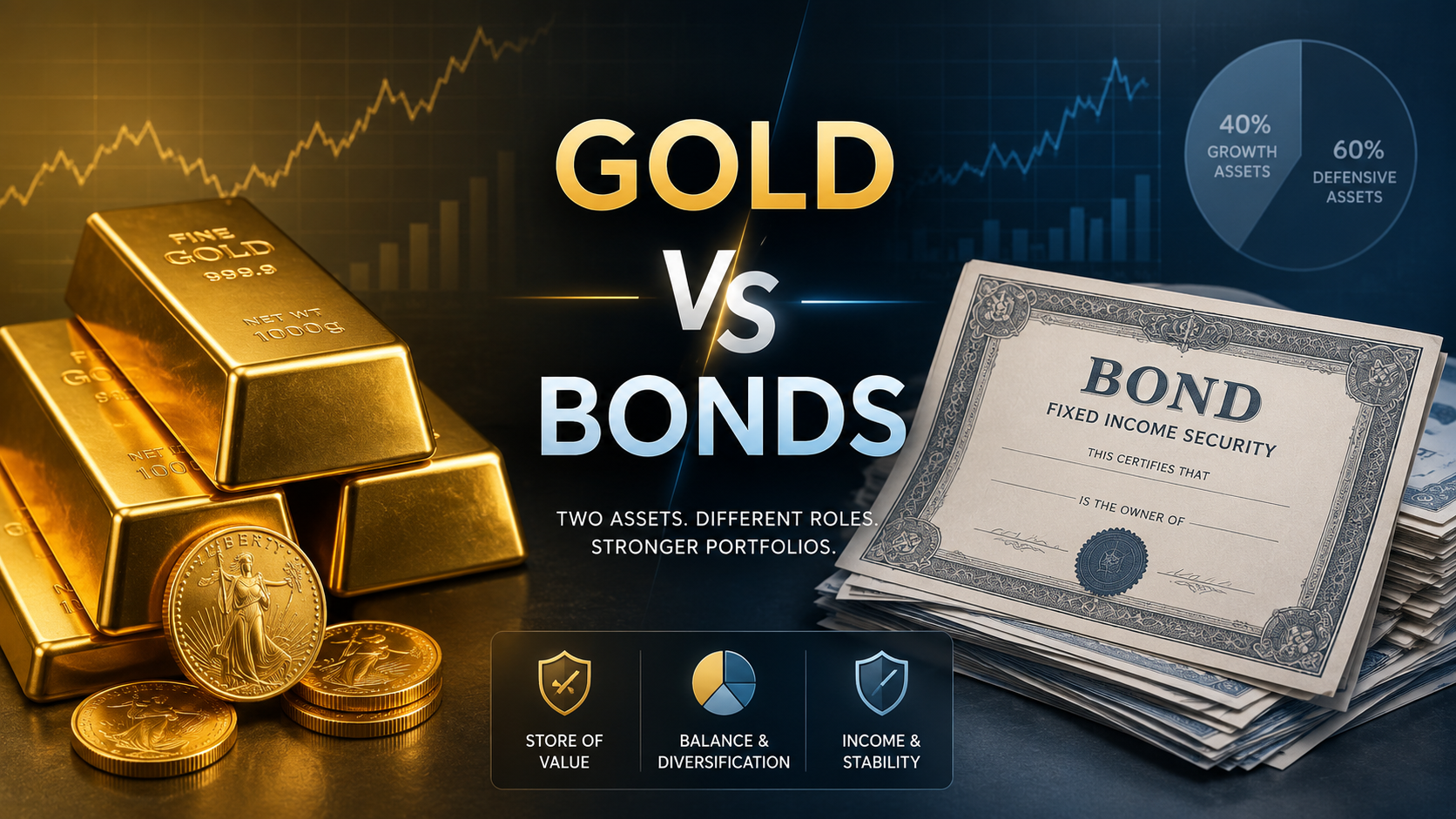
Gold vs Bonds: Which is better for your portfolio?
For most diversified portfolios, a complete replacement would be difficult to justify.
Gold and bonds solve different problems.
A person who replaces all bonds with gold gives up contractual income and maturity dates. A person who owns only bonds may remain highly exposed to inflation, rising real rates, government debt concerns, and episodes when stocks and bonds fall together.
A more balanced approach may treat high-quality bonds as the primary defensive and income-producing allocation, with gold serving as a smaller complementary diversifier.
Research from the World Gold Council has modeled hypothetical portfolios in which modest gold allocations reduced drawdowns and improved risk-adjusted results. Its 2026 analysis tested allocations ranging from 2.5 percent to 10 percent. However, the organization represents the gold industry, and its portfolio studies should be viewed as research rather than a universal allocation rule.
The appropriate percentage, including whether to own gold at all, depends on the household’s goals, age, income needs, other assets, time horizon, and tolerance for price fluctuations.
Related: Stocks Vs Gold During Financial Crisis
A Practical Way to Think About the Decision
Instead of asking which asset will rise more next year, consider what job each holding needs to perform.
Money intended for near-term spending generally requires liquidity and stability. Short-term, high-quality bonds may be better suited to that role.
Money intended to generate retirement income may benefit from a diversified bond portfolio or a ladder of individual securities.
Money set aside as a long-term hedge against monetary or geopolitical uncertainty may be a more natural candidate for gold.
A portfolio can therefore include:
- Stocks for long-term growth
- Bonds for income, stability, and liability matching
- Gold for additional diversification and protection against certain systemic risks
- Cash for immediate expenses and emergencies
The amounts should reflect the owner’s financial plan rather than a prediction about the next inflation report, interest-rate decision, or gold-price target.
Gold vs. Bonds: The Bottom Line
Bonds are generally better for predictable income, defined maturities, and managing future spending needs. High-quality, short- and intermediate-term bonds will usually be less volatile than gold.
Gold is generally better for diversification away from traditional financial assets, direct ownership without conventional credit risk, and potential protection during certain inflationary, currency, or geopolitical disruptions.
Neither asset is superior under every economic condition.
During a disinflationary recession, high-quality government bonds may outperform as interest rates decline. During an inflationary shock or loss of confidence in currencies and sovereign debt, gold may provide more effective diversification. During periods of rising real yields, gold and long-duration bonds can both struggle, although for different reasons.
For many long-term portfolios, the strongest answer is not gold or bonds. It is bonds for the functions bonds perform best, potentially supplemented by a measured gold allocation for risks bonds may not fully address.
