
Disclosure: We are reader-supported. If you buy through links on our site, we may earn a commission. Learn more.
Robert Kiyosaki is best known for teaching people to think differently about money, assets, debt, taxes, and financial independence.
In a recent Rich Dad Radio Show episode, he takes a step back from day-to-day market headlines and focuses on one of the biggest monetary turning points of the modern era: the Bretton Woods system.
Kiyosaki argues that the 1944 Bretton Woods agreement, the end of dollar-gold convertibility in 1971, and the rise of the petrodollar all help explain why savers often feel like they are falling behind, even when they are working hard and doing what they were taught to do.
For those who want the full lesson, watch the complete episode below.

Request Your Ultimate Guide to Gold & Silver
Protect Your Retirement Savings with Precious Metals.
For readers who prefer to skim, here are the key takeaways from Kiyosaki’s latest message.
Bretton Woods Made the Dollar the Center of the Global Financial System
Kiyosaki begins the episode by pointing back to 1944, when delegates from 44 nations met in Bretton Woods, New Hampshire, to create a new international monetary system after World War II. The agreement helped establish the International Monetary Fund and what became the World Bank, while also placing the U.S. dollar at the center of global trade and finance.
Under the Bretton Woods system, foreign currencies were fixed in relation to the U.S. dollar, and the dollar itself was tied to gold at $35 per ounce. That arrangement made the dollar uniquely powerful because other countries needed dollars for trade and settlement, while the United States held the central currency in the system.
Kiyosaki frames this as a kind of “financial operating system” written largely in America’s favor. In his telling, the U.S. had a major postwar advantage: much of the world had been damaged by war, while America had emerged stronger and held a large share of global gold reserves. That gave the dollar credibility and helped make it the foundation of the postwar monetary order.
Related: Diversify Your Savings with Physical Gold and Silver
The System Had a Built-In Weakness
A major theme of the episode is that Bretton Woods carried a contradiction from the beginning. The world needed more dollars to support trade and growth. But the more dollars the United States supplied, the harder it became to maintain the promise that those dollars could be converted into gold.
Kiyosaki ties this to what economists often call the Triffin dilemma: the reserve currency issuer must provide liquidity to the rest of the world, but doing so can eventually weaken confidence in the currency’s backing.
By the 1960s, pressure on the system was growing. The State Department’s history of the period notes that U.S. foreign aid, military spending, and foreign investment contributed to a surplus of dollars overseas, while the United States did not have enough gold to cover all dollars in circulation at the official $35-per-ounce rate.
Kiyosaki’s version of the lesson is simple: the system depended on trust, but the math eventually stopped working.
Related: Devlyn Steele Warns - Don't Rely on the Old Rules for Retirement
Nixon’s 1971 Decision Changed Money Forever
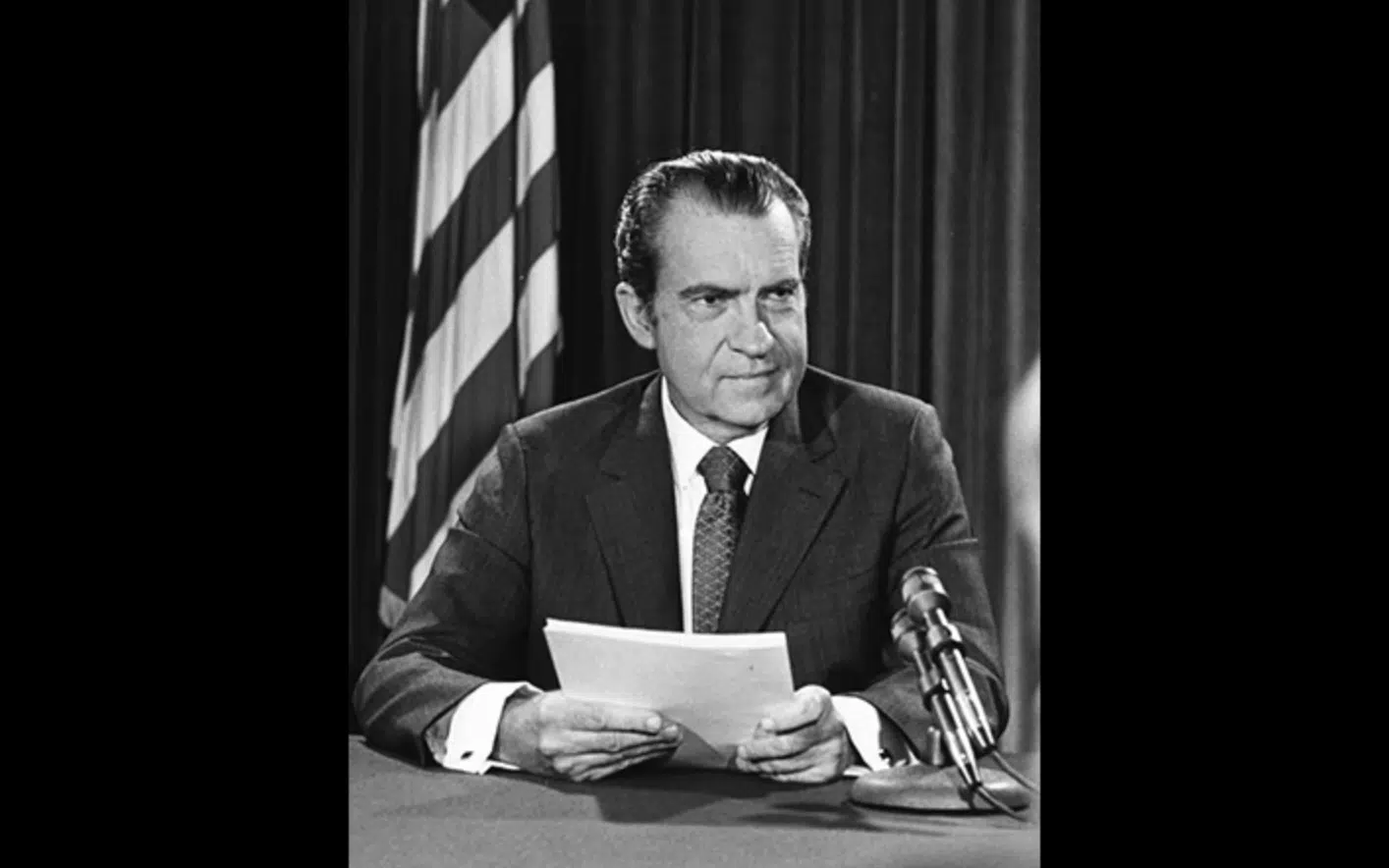
President Nixon prepares to announce new economic policies. (Photo courtesy of the Richard Nixon Library)
The turning point came on August 15, 1971, when President Richard Nixon announced that the United States would suspend the dollar’s convertibility into gold. The Federal Reserve History site describes this as the move that soon brought an end to the Bretton Woods system.
For Kiyosaki, this is the key moment when money changed. Before 1971, he argues, saving dollars made more sense because the dollar was still tied to gold. After 1971, he says the dollar became purely fiat currency, backed not by gold but by debt, government policy, and confidence.
This is where Kiyosaki connects the history lesson to his “Rich Dad” philosophy. In the episode, he contrasts his “poor dad,” who kept saving money and trusting pensions, with his “rich dad,” who saw the post-1971 world as a signal to own real assets instead of simply working for and saving dollars.
Related: Stocks vs Gold During Financial Crises - Which is Better?
Kiyosaki Says Savers Lose When Currency Loses Purchasing Power
One of Kiyosaki’s core arguments is that savers are punished in a fiat currency system because inflation quietly erodes purchasing power.
His point is not that saving is bad in every context. Rather, he argues that saving in a currency that can be continually expanded by governments and central banks leaves ordinary workers exposed. A person may have more dollars in nominal terms, but those dollars may buy less over time.
That is why Kiyosaki repeatedly tells his audience to focus on assets. In this episode, he specifically highlights real estate, businesses, gold, and silver as examples of assets that may offer protection when currency loses value.
Request Your Ultimate Guide to Gold & Silver
Protect Your Retirement Savings with Precious Metals.
Taxes, Interest, and Inflation Cut Differently Depending on What You Own
A memorable section of the episode centers on what Kiyosaki calls three “double-edged swords”: taxes, interest, and inflation.
His argument is that these forces hurt people who rely mainly on wages, savings accounts, consumer debt, and traditional financial habits. But those same forces can benefit people who own productive or inflation-sensitive assets.
For example, inflation hurts renters and cash savers, but may benefit owners of real estate, commodities, or businesses that can raise prices. Interest can crush consumers with credit card debt, but fixed-rate debt used to buy income-producing assets can become easier to repay if inflation reduces the real value of that debt over time.
Taxes, in Kiyosaki’s framework, tend to punish earned income while rewarding certain types of investment and business activity.
This is classic Kiyosaki: he is not simply talking about “getting rich.” He is urging listeners to understand which side of the financial system they are standing on.
The Petrodollar Gave the Dollar a Second Life

Robert Kiyosaki hosts Rich Dad Radio
Kiyosaki also argues that the dollar survived the end of gold convertibility because it found a new source of global demand: oil.
After the gold window closed, the dollar remained central to global trade in part because major commodities, especially oil, continued to be priced and settled largely in dollars. Kiyosaki refers to this as the petrodollar system, arguing that it gave the dollar a second life after Bretton Woods collapsed.
In his view, this matters because global demand for dollars has helped support U.S. borrowing, spending, and asset prices for decades. If that demand weakens, he suggests, Americans could feel the impact through inflation, higher costs, and reduced purchasing power.
BRICS and De-Dollarization Are Part of the Bigger Warning
Kiyosaki brings the issue forward to today by discussing BRICS and the possibility of more countries looking for alternatives to the dollar-based system.
This is not a new concern, but it has become more visible as countries including Brazil, Russia, India, China, South Africa, and newer BRICS-linked participants explore local-currency trade, alternative payment systems, and ways to reduce dependence on the U.S. dollar. Recent reporting has also pointed to BRICS discussions around linking digital currencies and improving cross-border payment alternatives.
Kiyosaki’s warning is that if countries need fewer dollars for global trade, some of the dollars held overseas could eventually return to the United States, putting more pressure on domestic prices. That is a serious claim and not a guaranteed outcome, but it fits his broader message: Americans should not assume the dollar’s dominant role will last forever.
Related: Gold & Silver 101 - Webinar Replay and Recap
The Bigger Lesson: Don’t Just Work for Money, Understand Money
The strongest takeaway from the episode is not simply “buy gold” or “buy real estate.” It is that people need to understand how the money system works.
Kiyosaki’s message is that wages, savings, pensions, and paper assets may not be enough if the underlying currency is steadily losing purchasing power. His answer is to focus on financial education, cash-flowing assets, hard assets, and ownership.
That does not mean every listener should rush into real estate, gold, silver, oil, or business ownership without doing their homework. These assets carry risks, costs, taxes, and timing issues. But Kiyosaki’s broader framework is worth considering: in a world shaped by debt, deficits, inflation, and changing global power dynamics, financial survival may require more than simply earning a paycheck and saving what is left.
Don't Rely on the System...
Robert Kiyosaki’s latest episode uses Bretton Woods as a lens for understanding today’s financial pressures. His argument is that the modern dollar system did not appear by accident. It was built through a series of major decisions: the 1944 Bretton Woods agreement, the 1971 end of gold convertibility, and the later rise of the dollar-centered oil trade.
Whether viewers agree with every part of his interpretation or not, the episode raises an important question for savers: are you building wealth in a way that protects purchasing power, or are you relying on a currency system that may be working against you?
For Kiyosaki, the answer remains the same as it has been for decades: the rich do not simply work for money. They learn how money works, then use that knowledge to acquire assets.
