
Disclosure: We are reader-supported. If you buy through links on our site, we may earn a commission. Learn more.
In an economy defined by record government debt, rolling recession fears, and a Federal Reserve that keeps reaching for the rate-cut button, a lot of conservatives are asking the same basic question:
How do I protect my savings if Washington and Wall Street keep screwing this up?
That’s exactly what American Hartford Gold’s Senior Director Machi Block tackled in the “Gold and Silver 101: Defend Against Uncertainty” webinar. You can watch the full webinar below.
Webinar originally aired November 20, 2025.
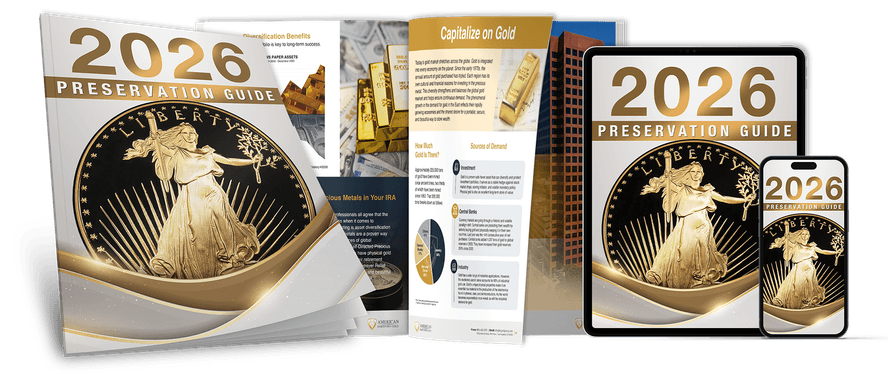

Request Your Free 2026 Gold IRA Guide:
Protect Your Retirement Savings with Physical Gold & Silver.
Below is a reader-friendly recap for those who prefer to skim the key points instead of sitting through the full event.
Why Americans Are Turning to Gold and Silver Right Now
Machi opens the webinar by putting into words what many conservative Americans have been sensing for months: something is fundamentally wrong with the financial direction of the country.
The U.S. dollar is steadily losing strength, federal debt has surged past $38 trillion with no serious effort in Washington to rein it in, and the stock market is floating on what many consider a historic bubble driven by a handful of mega-cap tech giants and unproven AI hype.
Meanwhile, the average American—relying on retirement accounts like 401(k)s, IRAs, and brokerage portfolios—is fully exposed to these risks whether they realize it or not.
But as Machi points out, the most powerful financial players in the world aren’t ignoring these warning signs—they’re responding to them. Central banks have been quietly reducing their holdings of U.S. Treasuries, shifting away from the very instruments that used to be considered the global safe haven.
Even more telling, 96% of central banks say they plan to expand their gold reserves in the coming years, and a growing number are deliberately cutting their exposure to the U.S. dollar—not just “diversifying,” but actively stepping back from the currency.
The signal is impossible to miss: while everyday Americans are still heavily tied to dollar-based assets, major global institutions are preparing for a potential currency and bond crisis by increasing their gold positions. They see what’s coming, and they’re quietly fortifying themselves while the public remains largely unprotected.
Related: American Hartford Gold Review - Best for Gold IRAs?
The Dollar’s Worst Year in Half a Century
According to Machi, the dollar just posted its worst year in 52 years. At the same time:
- Foreign buyers are pulling away from US debt
- Central banks are buying record amounts of gold instead
- Around 16% of central banks are actively cutting their dollar exposure – up from 11% last year
For a right-leaning saver who’s watched Washington spend like there’s no tomorrow, this fits the pattern: Runaway spending, endless deficits, and a deliberate policy of devaluing the currency.
Project that forward:
- The US is already at $38+ trillion in debt
- At $2 trillion in new deficits per year, Machi notes we’re staring at $60 trillion in debt within a decade
- Interest payments alone are now the single biggest line item in the federal budget
At some point, the numbers simply don’t add up for the dollar.
Related: How to Buy Gold and Silver (Tax-Free) with Your 401(k) or IRA
Rate Cuts, Trump’s Weaker Dollar Strategy & What It Means for Metals
Machi explains that the Federal Reserve has already cut interest rates twice this year and may be preparing for another reduction.
While the official justification is to engineer a “soft landing” and keep the economy out of recession, the real-world effect is far simpler: cheaper money, renewed inflation pressure, and a steadily weakening dollar. Rate cuts don’t just stimulate borrowing—they also erode the value of savings and dilute the currency Americans depend on.
He then connects this trend directly to the broader goals of the Trump administration. Trump has made it clear that he wants to revive America’s manufacturing base and reposition the U.S. as a major exporting powerhouse. The fastest way to supercharge exports is with a weaker dollar, because a cheaper currency makes American goods more affordable on the global market.
Achieving that requires ongoing devaluation—more rate cuts, more liquidity, and more money creation. From an “America First” perspective, the playbook is understandable: rebuild domestic production. But for savers who keep the bulk of their wealth in dollar-based assets, the cost of that strategy shows up directly in lost purchasing power.
Gold and silver, however, move in the opposite direction. As the dollar declines, hard assets historically rise, acting as a counterbalance against inflation and currency weakness. That’s why Machi frames the moment so bluntly: the same policies that challenge the strength of your dollars tend to fuel the strength of physical precious metals. For gold and silver buyers, this environment is an opportunity.
For those holding only traditional dollar-denominated investments, it’s a problem that grows every time the Fed moves to “stimulate” the economy.
Request Your Free 2026 Gold IRA Guide:
Protect Your Retirement Savings with Physical Gold & Silver.
The Stock Market Bubble & AI Hype
Machi dedicates a significant part of the webinar to what he sees as one of the most dangerous blind spots in today’s financial landscape: the stock market’s growing disconnect from economic reality.
He points out that by several traditional valuation measures, the S&P 500 is more overvalued than at any other time in U.S. history. The average stock, he notes, is trading at roughly 535% of its actual book value—a figure that dwarfs the numbers seen before the 1929 crash, when stocks were trading around 430% above what the companies were truly worth.
By comparison, today’s bubble is, as he describes it, 17 times larger than the dot-com mania and eight times bigger than the 2008–2009 financial crisis.
Compounding the problem is the frenzy surrounding artificial intelligence. Investors are pouring money into AI-related companies despite the fact that many of them have yet to demonstrate meaningful long-term cash flows.
At the same time, institutional investors are holding the lowest levels of cash in 15 years, meaning they’re almost fully invested at today’s inflated prices. Much of the index performance is also being carried by just a handful of mega-cap tech giants, concentrating risk even further at the top of the market.
What makes this even more concerning is that the warnings aren’t coming from fringe analysts—they’re coming from the biggest names on Wall Street. Legendary investors and major banks are openly cautioning about a looming currency crisis, a bond market breakdown, and the possibility of a 20–25% market decline before the end of 2025.
According to Machi, this creates a precarious situation where every additional dollar someone puts into the stock market doesn’t add safety—it adds exposure. At these levels, he argues, investors are no longer buying opportunity; they’re buying risk.
Related: Cracks in America's Retirement System Are Showing
How Gold and Silver Have Been Performing
Machi highlights just how dramatically precious metals have outperformed:
Over the last 12 months:
- Gold: up around 60%
- Silver: up around 80%
- S&P 500: up roughly 13%
- NASDAQ: up about 18%
Since 2000:
- Gold: up roughly 1,285%
- Silver: up about 1,270%
- S&P 500: ~600%
- NASDAQ: ~480%
- The US dollar has lost over 53% of its purchasing power in that same period
His point: gold and silver have not only preserved wealth, they’ve massively outperformed traditional paper assets over the long term, especially in inflationary and crisis-driven periods.
And despite these big moves, Machi argues we’re still early in this bull run, with:
- Big banks like Goldman Sachs, UBS, Citi, and JPMorgan talking about gold in the $4,900–$7,000+ range in the coming years
- Forecasts of silver potentially breaking well into triple digits in the next major leg higher
Again, those are their projections, not guarantees – but the fact that big Wall Street names are now openly telling Americans to own gold is a major shift.
Learn More by Visiting American Hartford Gold's Website.
Why People Buy Precious Metals: Long-Term Hedge and Near-Term Opportunity
Machi breaks it down into two core reasons people move into gold and silver:
1. Long-Term Protection (Wealth Insurance)
- Gold is a store of value and a hedge against inflation
- It’s designed to maintain purchasing power as paper currencies are devalued
- It functions like “wealth insurance” – especially if you’re worried about the dollar 5–10 years from now
2. Immediate Opportunity (Bull Market Upside)
- We’re in a strong bull run for metals
- Gold and silver have been the best-performing mainstream assets this year
- For many savers, it’s both defensive and offensive:
- Protection against the dollar
- Plus potential upside if the crisis fully unfolds
Two Main Ways to Own Gold and Silver with American Hartford Gold
Machi then walks through the mechanics of getting into physical metals with the company. There are two main paths:
1. Cash Purchases (Non-Retirement)
The first option is a straightforward cash purchase, which applies to money sitting in a bank account, a money market fund, CDs, or any non-retirement brokerage account.
The process is deliberately simple. You start by opening an account with American Hartford Gold, then fund it either by wire transfer or by mailing a check. From there, you’ll speak directly with a company director who walks you through your goals, time horizon, and liquidity needs. Based on that conversation, they help you assemble a custom portfolio of physical gold and silver—usually a mix of coins and bullion, depending on your objectives.
Once everything is finalized, the metals are shipped directly to your doorstep in fully insured, unmarked packaging. Machi emphasizes that there is no sales tax on these transactions and no reporting requirements tied to the typical purchase amount. The minimum entry point is about $5,000, but there’s effectively no upper limit.
Another advantage, he notes, is that American Hartford Gold operates a true two-way marketplace. When you eventually want to sell your metals, the company commits to buying them back without charging additional fees. The entire system is designed so clients don’t need to become precious-metals experts themselves—the firm guides the process from start to finish.
Request Your Free 2026 Gold IRA Guide:
Protect Your Retirement Savings with Physical Gold & Silver.
2. Retirement Accounts (Gold & Silver IRAs)
The second path involves using retirement accounts such as old 401(k)s, Traditional IRAs, Roth IRAs, or other eligible plans. Here, American Hartford Gold sets up a self-directed IRA, which is the structure that allows you to hold physical metals inside a retirement account rather than paper-based funds.
Opening this Gold IRA is typically done through a short application signed electronically via DocuSign. Once the account is created, their back-office team steps in to handle the heavy lifting: they join a call with your current custodian, assist with liquidating the portion you want to move, and complete all transfer documents on your behalf.
After the funds arrive in your new self-directed IRA, you’ll again work with a director to build the right mix of gold and silver for your needs. Instead of being shipped to your home, these metals are stored in a secure, private depository—locations include Delaware, Dallas, and Nevada—completely outside the banking system.
You still own the metal personally; it is physically allocated to you, fully insured (with coverage Machi says comes through Lloyd’s of London), and can be sold back at any time. If you prefer, you can even take an in-kind distribution later and have the metals shipped directly to your home, subject to normal IRA tax rules.
Machi also clarifies the cost structure. IRA storage is billed as a flat annual fee—roughly $225 per year for non-segregated storage or $275 for segregated storage—and that fee stays the same whether your account holds $10,000 or $10 million in metals.
For customers who don’t want metals shipped to their home on the cash-purchase side, third-party vaults are also available, typically charging around 0.5% of the stored value per year.
Learn More by Visiting American Hartford Gold's Website.
How Much Gold and Silver? 10%… or More?
One audience member asked about the usual “10–20% metals” allocation many financial advisors mention.
Machi’s response:
- That rule of thumb mostly comes from traditional financial advisors who make their fees managing paper assets
- In “normal” times with low inflation and no major dollar risk, 10–15% might be reasonable
- But in today’s environment – with record debt, dollar devaluation, inflated asset prices, and recession risk – many of their clients are choosing to go much higher
He doesn’t give a one-size-fits-all number. Instead, he frames it as:
- If 80–90% of your net worth is sitting in assets that could drop 40–60% in a serious crash
- And only 10–15% is in metals
- Is that really a sufficient hedge for you personally?
Most clients, he notes, end up with some mix of:
- Gold for stability & preservation
- Silver for growth & upside
Common blends he mentions:
- 40% gold / 60% silver if you want more growth
- 60% gold / 40% silver if you want more stability
- But he stresses there’s no “correct” allocation that fits everyone
Why American Hartford Gold?
In the last section, Machi explains why he believes American Hartford Gold stands out in the industry:
- Largest precious metals dealer in the US, with over $3.5 billion in metals shipped in recent years
- 10+ years in business
- A+ rating with the Better Business Bureau
- Thousands of positive reviews across sites like Trustpilot and Google
- Repeatedly featured on the Inc. 5000 list of fastest-growing private companies
- A transparent “About Us” page with a welcome video showing:
- The CEO and president
- The staff and shipping department
- Their actual office environment
He also emphasizes:
- No-fee buyback commitment for customers who want to sell
- A full-service, hands-on team dedicated to making the process simple and understandable
- Current promotions such as:
- Free silver for qualifying purchases (e.g. $500 in free silver for each $50,000 invested, up to a stated cap)
- Free home safe for certain cash purchases
(Exact promotions can change, so readers should confirm current offers directly with the company.)
Request More Information by Visiting American Hartford Gold's Website.
Prepare While There’s Still Time
Machi ends the webinar with a stark assessment of where the country is heading. The dollar continues to lose strength, recession indicators are flashing, and federal debt and deficits are accelerating with no sign of restraint from Washington.
At the same time, the institutions closest to the global financial system—central banks, major U.S. banks, and some of the world’s wealthiest investors—are all quietly increasing their gold reserves. Add in the growing volatility across bond, equity, and currency markets, and it becomes clear why so many large players are repositioning themselves before the next shock hits.
Against that backdrop, Machi argues that gold and silver have demonstrated exactly what they are designed to do. They’ve outperformed stocks and bonds in both the short and long term, and they are being accumulated aggressively by the very institutions that usually benefit from the status quo.
Despite their strong performance this year, he believes precious metals are still in the early stages of a much larger move—especially if current economic trends continue.
For Americans who don’t trust the federal government, the Federal Reserve, or Wall Street to suddenly embrace fiscal discipline, Machi frames the moment in simple terms: if you believe Washington will keep printing, spending, and inflating the currency, then owning physical gold and silver is common sense.
How to Take the Next Step
If you’d like to talk through:
- Whether a cash purchase or Gold IRA makes more sense for you
- How much of your portfolio to shift into metals
- What mix of gold vs. silver might fit your situation
Machi invites viewers to call American Hartford Gold directly at: 1-866-824-5564
You can also download the 2026 Gold IRA Information Guide below and share it with friends and family who may need a wake-up call on what’s happening to the dollar. Discover why owning real, tangible assets is becoming more important than ever.
