
Disclosure: We are reader-supported. If you buy through links on our site, we may earn a commission. Learn more.
Finding a gold-colored quarter can be exciting. At first glance, it may appear to be a rare U.S. Mint error, a valuable commemorative coin, or even a quarter made from solid gold.
In most cases, however, a gold-plated quarter is worth only 25 cents to a few dollars.
The gold coating is usually extremely thin and contains very little recoverable precious metal. Some gold-plated quarters may sell for a modest premium because of their appearance, packaging, or novelty value, but they generally should not be considered gold investments.
There is one notable exception. In 2016, the U.S. Mint released an official quarter-dollar coin made from 24-karat gold. That coin contains one-quarter troy ounce of pure gold and can be worth considerably more than an ordinary plated quarter.
Understanding the difference between a privately plated quarter and a genuine gold coin is essential.

Request Your Ultimate Guide to Gold & Silver
Protect Your Retirement Savings with Precious Metals.
How Much Is a Gold-Plated Quarter Worth?
Most gold-plated quarters have an estimated resale value ranging from face value to several dollars.
Type of quarter | Typical estimated resale range |
|---|---|
Loose gold-plated circulating quarter | $0.25 to $1 |
Gold-plated quarter in a capsule or display | $1 to $5 |
Small commemorative plated set | Several dollars, depending on packaging |
Complete gold-plated State Quarter collection | Varies based on presentation and buyer demand |
Genuine 2016-W Standing Liberty gold quarter | Gold value plus possible collector premium |
These are general estimates, not formal coin-market price-guide values. Actual offers may be lower, and some coin dealers may not be interested in purchasing individual plated quarters at all.
Unlike bullion coins, gold-plated quarters do not have a standardized precious-metals value. Their resale price depends primarily on whether a buyer finds the coin or display attractive.
Did the U.S. Mint Make Gold-Plated Quarters?
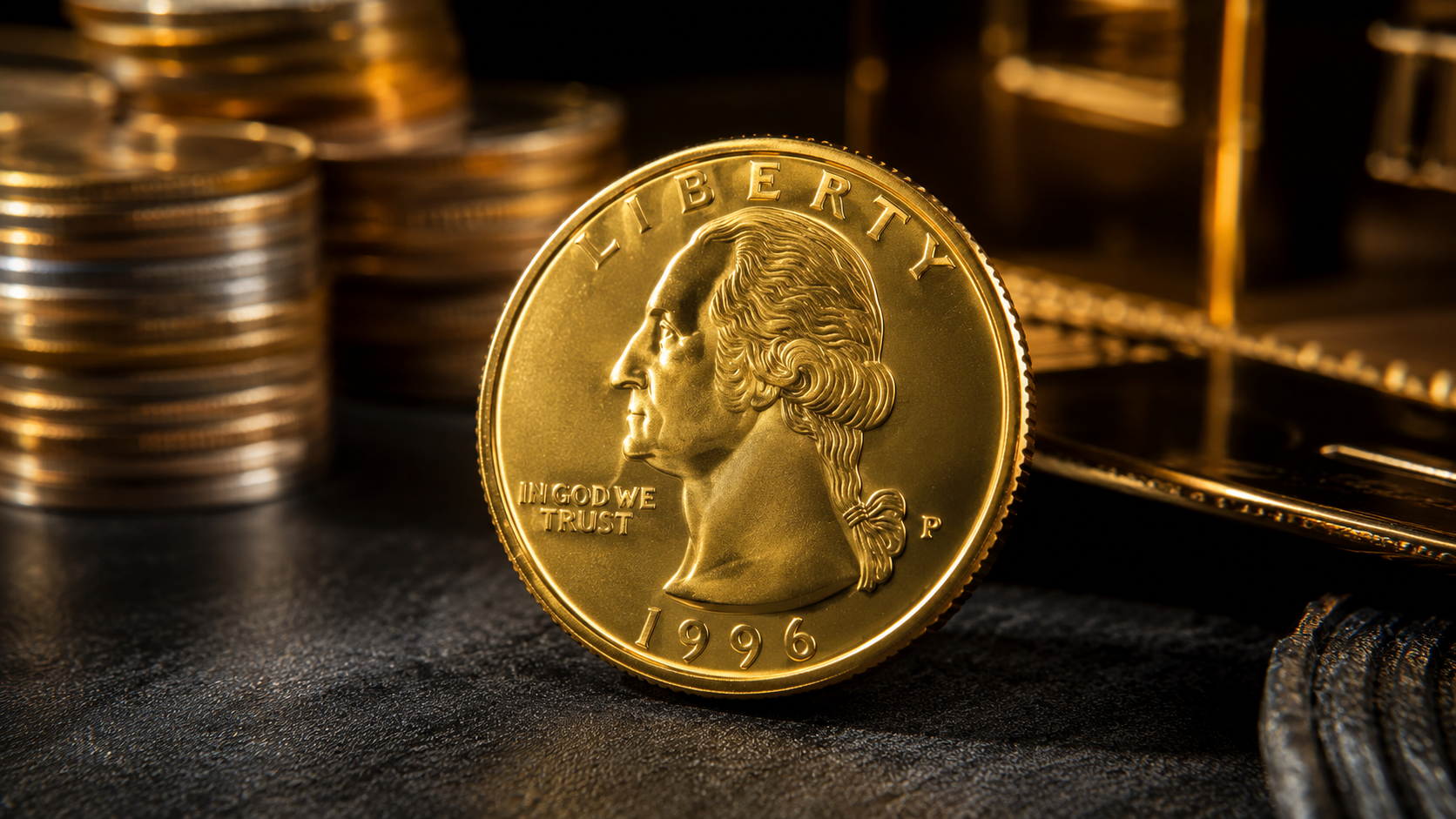
Gold-plated quarter
No. The U.S. Mint states that it has never produced or sold gold-plated or silver-plated coins.
The gold-plated quarters commonly found in commemorative sets were altered by private companies after the coins left the Mint. These businesses typically obtained ordinary circulating quarters and applied a thin layer of gold to the surface.
The underlying coin is still a genuine U.S. quarter, but the gold coating is not an official Mint feature.
This distinction is important because private sellers may use descriptions such as:
- 24-karat gold-plated
- Collector’s edition
- Limited release
- Commemorative gold quarter
- Historic State Quarter collection
These phrases may sound impressive, but they do not mean the coin is made from solid gold or was issued by the U.S. Mint as a precious-metals product.
Private companies commonly plate genuine U.S. coins, but the altered coins should not be marketed deceptively or misrepresented as official Mint-issued gold products.
Related: America's Debt Crisis is Unsustainable
Why Is the Gold Plating Worth So Little?
The term “24-karat gold-plated” refers to the purity of the gold coating, not the amount of gold on the coin.
A quarter can be coated with nearly pure gold while containing only a tiny quantity of it. The plating is generally extremely thin, although the exact thickness varies depending on the company and process used.
Because the coating contains so little gold, recovering and refining it would usually cost more than the gold itself is worth.
A modern circulating quarter is made primarily from copper and nickel. According to the U.S. Mint, a standard quarter weighs 5.67 grams and consists of a copper core with copper-nickel outer layers.
Beginning in 1965, standard circulating quarters changed from the 90% silver composition used previously to a copper-nickel clad composition. The Mint has produced some silver quarters for special collector sets since then, but those were not standard circulation issues.
Adding a thin layer of gold does not turn an ordinary copper-nickel quarter into a bullion coin.
Can Gold Plating Reduce a Quarter’s Value?
Yes, particularly if the underlying coin was collectible before it was plated.
Serious coin collectors generally prefer coins with their original surfaces intact. Plating, polishing, cleaning, painting, or chemically altering a coin can reduce its numismatic appeal.
For an ordinary modern quarter, this may not make much difference because the coin probably had little collector value before it was plated.
However, plating a rare date, valuable error coin, silver quarter, or high-grade collectible could lower its value.
Plating may also make a coin ineligible for a normal numerical grade from a professional grading service. Depending on the alteration and the grading company’s policies, the coin may be returned without encapsulation or identified as having altered surfaces.
Before cleaning, plating, polishing, or modifying any potentially valuable coin, have it examined by a reputable coin dealer or grading service.
Are Gold-Plated State Quarters Valuable?
Gold-plated State Quarters are among the most common plated coins on the secondary market.
The U.S. Mint’s 50 State Quarters Program ran from 1999 through 2008. Quarters honoring Washington, D.C., and the five U.S. territories followed in 2009.
Private companies took advantage of the program’s popularity by selling gold-plated versions of the quarters in display cases, albums, capsules, and commemorative collections.
Some of these sets originally sold for far more than the face value of the coins they contained. However, their resale value is usually based on presentation and novelty rather than gold content.
A complete set in an attractive display may sell for more than the individual quarters would bring separately. Even then, the value comes primarily from the packaging and completeness of the collection.
The thin gold coating itself adds very little intrinsic value.
Request Your Ultimate Guide to Gold & Silver
Protect Your Retirement Savings with Precious Metals.
What Is the Genuine 2016 Gold Quarter?
The United States has issued one modern quarter-dollar coin made from genuine gold.
The 2016-W Standing Liberty Centennial Gold Coin was released to commemorate the 100th anniversary of the original Standing Liberty quarter design.
Unlike an ordinary plated quarter, this coin is made from .9999 fine, 24-karat gold throughout.
Its official specifications include:
Feature | 2016-W Standing Liberty gold quarter |
|---|---|
Gold content | 0.25 troy ounce |
Purity | 99.99% gold |
Weight | 7.776 grams |
Diameter | 22 millimeters |
Mint | West Point |
Mintmark | W |
Legal-tender denomination | Quarter dollar |
Maximum mintage | 100,000 |
Original issue price | $485 |
Although the coin has a face value of 25 cents, its actual market value is tied primarily to the price of gold and its collector demand.
Because it contains one-quarter troy ounce of gold, its contained-gold value equals approximately 25% of the current gold spot price.
For example, if gold is trading at $4,000 per ounce, the coin contains approximately $1,000 worth of gold before accounting for any dealer spread or collector premium.
An actual dealer offer may be above or below that amount depending on the coin’s condition, original packaging, certificate of authenticity, grading, market demand, and the dealer’s buy-sell spread.
The genuine coin carries the inscriptions “AU 24K” and “1/4 OZ.” on its obverse. These markings make it much easier to distinguish from an ordinary plated Washington or State Quarter.
How to Tell Whether a Quarter Is Plated or Solid Gold
The easiest place to start is with the coin’s design, date, inscriptions, size, and weight.
A coin is probably an ordinary plated quarter if it features George Washington, has a State Quarter or other modern circulating reverse, and looks like a standard quarter with a gold-colored surface.
It is also likely plated if it lacks the inscriptions “AU 24K” and “1/4 OZ.”
The genuine 2016 gold quarter has several identifying features:
- Standing Liberty design
- 2016 date
- West Point “W” mintmark
- “AU 24K” inscription
- “1/4 OZ.” inscription
- Weight of approximately 7.776 grams
- Diameter of 22 millimeters
- Official U.S. Mint packaging and certificate, when complete
A normal modern quarter measures approximately 24.26 millimeters across and weighs 5.67 grams. The genuine 2016 gold quarter is slightly smaller in diameter but heavier because gold is much denser than copper and nickel.
Do not rely on color alone. Coins can be plated, painted, toned, chemically treated, or counterfeited.
A precise scale, caliper measurements, and professional examination provide stronger evidence than appearance.
Free Gold IRA Kit:
Protect Your Retirement Savings with Physical Gold & Silver. Request Your Copy Today.
Could a Gold-Colored Quarter Be a Mint Error?
It is possible, but highly unlikely.
One famous error sometimes mentioned in discussions of gold-colored quarters is the 2000-P Sacagawea dollar and Washington quarter mule.
This error was struck using the obverse die of a Washington quarter and the reverse die of a Sacagawea dollar. It was struck on a golden-colored dollar planchet, making it look very different from a standard quarter.
However, the mule is larger and heavier than an ordinary quarter because it was struck on a dollar planchet.
A genuine example would show George Washington on the front and the Sacagawea dollar eagle design on the reverse.
This rare error should not be confused with a normal quarter that was privately plated after leaving the Mint.
Anyone who believes they have a major Mint error should avoid cleaning, scratching, filing, or chemically testing the coin. It should be submitted to a recognized authentication service such as PCGS or NGC.
Related: Phillip Patrick Discusses Gold, U.S. Debt, and What it Means for Your Retirement
Are Gold-Plated Quarters a Good Investment?
Gold-plated quarters are generally not suitable for investors seeking exposure to gold.
They contain almost no recoverable precious metal, have limited dealer demand, and can be difficult to resell for more than a small amount.
Any premium paid for a plated quarter is usually tied to its appearance, packaging, or novelty appeal.
Investors who want to own physical gold are generally better served by products that clearly disclose their weight and purity, such as:
- American Gold Eagles
- American Gold Buffalos
- Canadian Gold Maple Leafs
- Recognized gold bars
- Fractional gold bullion coins
- The 2016-W Standing Liberty gold quarter
These products contain measurable quantities of gold and trade within established precious-metals markets.
A plated quarter can still make an attractive gift, inexpensive collectible, or conversation piece. It should simply be purchased with realistic expectations.
Can You Spend a Gold-Plated Quarter?
A plated quarter may still be accepted for its 25-cent face value, but merchants, banks, coin-counting machines, and vending machines may reject altered coins.
The plating does not increase the coin’s legal-tender denomination. A plated quarter is not worth more than 25 cents when used as currency.
Because the coin has been altered, acceptance may depend on the merchant or financial institution.
How to Sell a Gold-Plated Quarter
Before selling a gold-colored quarter, determine what type of coin you have.
It could be:
- An ordinary plated circulating quarter
- A silver quarter that was later plated
- A privately issued commemorative set
- A genuine Mint error
- The 2016-W Standing Liberty gold coin
For ordinary plated quarters, possible selling venues include online marketplaces, coin shows, flea markets, antique stores, and collector groups.
Complete sets may be more desirable than individual coins, especially when they include attractive cases, certificates, or organized displays.
Describe the coin accurately. Use the term “gold-plated quarter” rather than “gold quarter” unless the coin is genuinely made from gold.
When researching prices online, focus on completed sales rather than asking prices. Sellers can list a plated quarter for almost any amount, but an asking price does not show what a buyer was actually willing to pay.
Frequently Asked Questions
Is a gold-plated quarter worth more than 25 cents?
It may sell for more than face value as a novelty item, but the gold itself adds virtually no intrinsic value. Most individual examples are worth between 25 cents and a few dollars.
Are gold-plated quarters made with real gold?
The coating may contain real gold and may even be described as 24-karat. However, the layer is usually extremely thin. The coin underneath is generally an ordinary copper-nickel quarter.
Did the U.S. Mint issue gold-plated State Quarters?
No. The U.S. Mint has never produced or sold gold-plated quarters. Private companies applied the plating after obtaining genuine U.S. coins.
How much is the 2016 gold quarter worth?
Its value changes with the gold market. Because it contains one-quarter troy ounce of pure gold, its contained-gold value is approximately 25% of the current gold price per ounce.
Condition, packaging, grading, collector demand, and dealer spreads can increase or decrease the actual purchase or resale price.
Is a gold-plated quarter worth grading?
Usually not. The grading fee may exceed the value of the coin, and the plating may prevent it from receiving a standard numerical grade.
Professional authentication may make sense if the underlying coin appears rare, valuable, or unusual.
Does gold plating make a quarter illegal?
Gold plating itself does not automatically make a quarter illegal to own. However, altered coins should not be sold fraudulently or misrepresented as official solid-gold U.S. Mint products.
Gold-Plated Quarters - Key Takeaways
Most gold-plated quarters are worth 25 cents to a few dollars, not hundreds or thousands of dollars.
The coating may contain real gold, but there is usually far too little of it to provide meaningful bullion value. These coins are best viewed as novelty collectibles rather than precious-metals investments.
The major exception is the 2016-W Standing Liberty Centennial Gold Coin, which contains one-quarter troy ounce of .9999 fine gold.
Its value is tied to both the gold price and collector demand, which means it can be worth more than $1,000 when gold prices are elevated.
Before assuming a gold-colored quarter is valuable, check its date, design, inscriptions, mintmark, dimensions, weight, and packaging.
In the coin market, the difference between gold-plated and solid gold can mean the difference between 25 cents and more than $1,000.
